
The Odyssey
Released July 17, 2026
Written and Directed by Christopher Nolan (based on the poem by Homer)
* No Spoilers - but some brief discussion about the overall themes and story, including some scene descriptions. *
A mesmerizing, contemplative, and grandiose rendition of Homer’s legendary epic. Christopher Nolan brings the millennia old legend to life with all the scale and spectacle it deserves. The mythical locations, creatures, and events are stylized and not exactly period accurate, but they feel grounded and real. As a fan of Nolan and ancient myth, this has been one of my most anticipated films of the year. The massive ensemble cast and distinction of being the first film shot entirely in IMAX comes with appropriately huge expectations. While not perfect, The Odyssey meets and often exceeds almost every one of those expectations, delivering a theatrical experience that reminds me why I love cinema.
The film is a direct adaptation, faithful in what is depicted but drastically different in how those events are interpreted. Especially when it comes to the characterization of Odysseus and by extension the underlying message of the story. Rather than a reinterpretation, Nolan’s rendition is a meta-commentary on myth, heroes, and storytelling itself. If Homer was the bard extolling through song the heroism of Odysseus, then Nolan is the journalist revealing hidden truths only implied in the text. Unlike the resolute, prideful, and brave mythical figure from the poem, the film focuses on the pain and guilt of a man struggling with the consequences of his actions. While not wholly adopting the poem’s underlying themes Nolan does not completely reject them either. Instead, he offers an introspective pivot that delves into Odysseus’ psyche. The events are the same, but we experience them through the mind of a beleaguered and plagued soul, haunted by his past and its implications for the world around him.
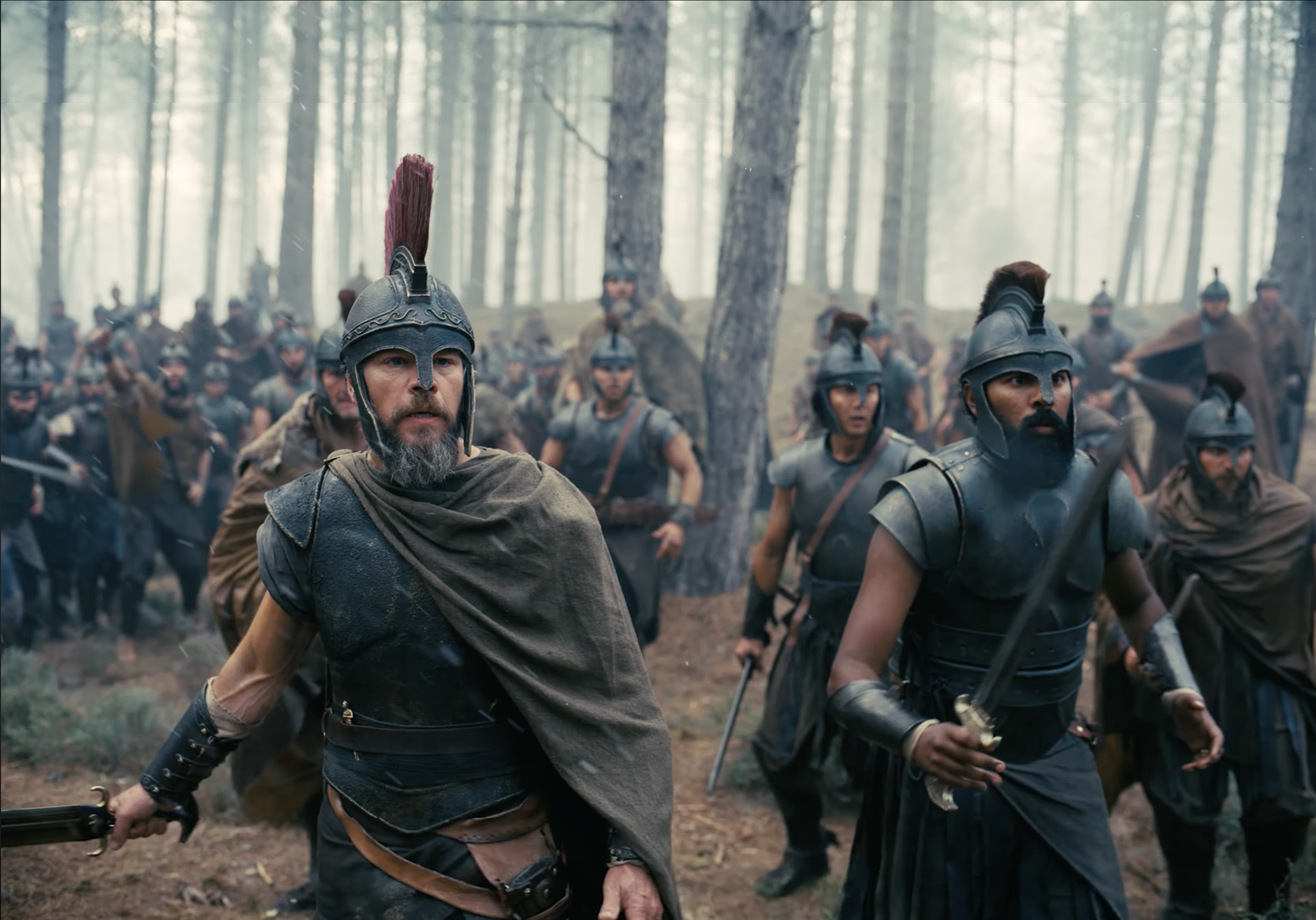
Speaking of accuracy, to criticize the casting of “non-white” actors in a story about an empire spanning across the Mediterranean and North Africa is ridiculous. Ancient Greeks likely did not resemble members of the cast with North or Western European backgrounds, nor did they speak English, but this is an adaptation of a fictional story featuring monsters and cyclopses. So complaints about historical accuracy ring hollow when those same critics have no issue with Gerard Butler in 300 playing a Greek with a Scottish accent, or Russell Crowe, an Australian, playing a Roman Spaniard in Gladiator. To be clear I am not criticizing those casting choices or the Northern Europeans in The Odyssey, I am simply illustrating how the controversy feels disingenuous, hypocritical, and racist.
Like the poem, the film is a non-linear narrative told by characters often flashing back to past incidents. Perfectly aligning with what Nolan is already known for. The plot moves from each set piece with striking efficiency and the film’s pacing remains impressive even with its nearly three-hour runtime. It’s packed with epic moments but balances dialogue, action, and character development without ever neglecting one element at the expense of another. A brilliantly packaged experience that showcases Nolan’s strength at presenting spectacle while exploring deeper character moments and philosophical perspectives.
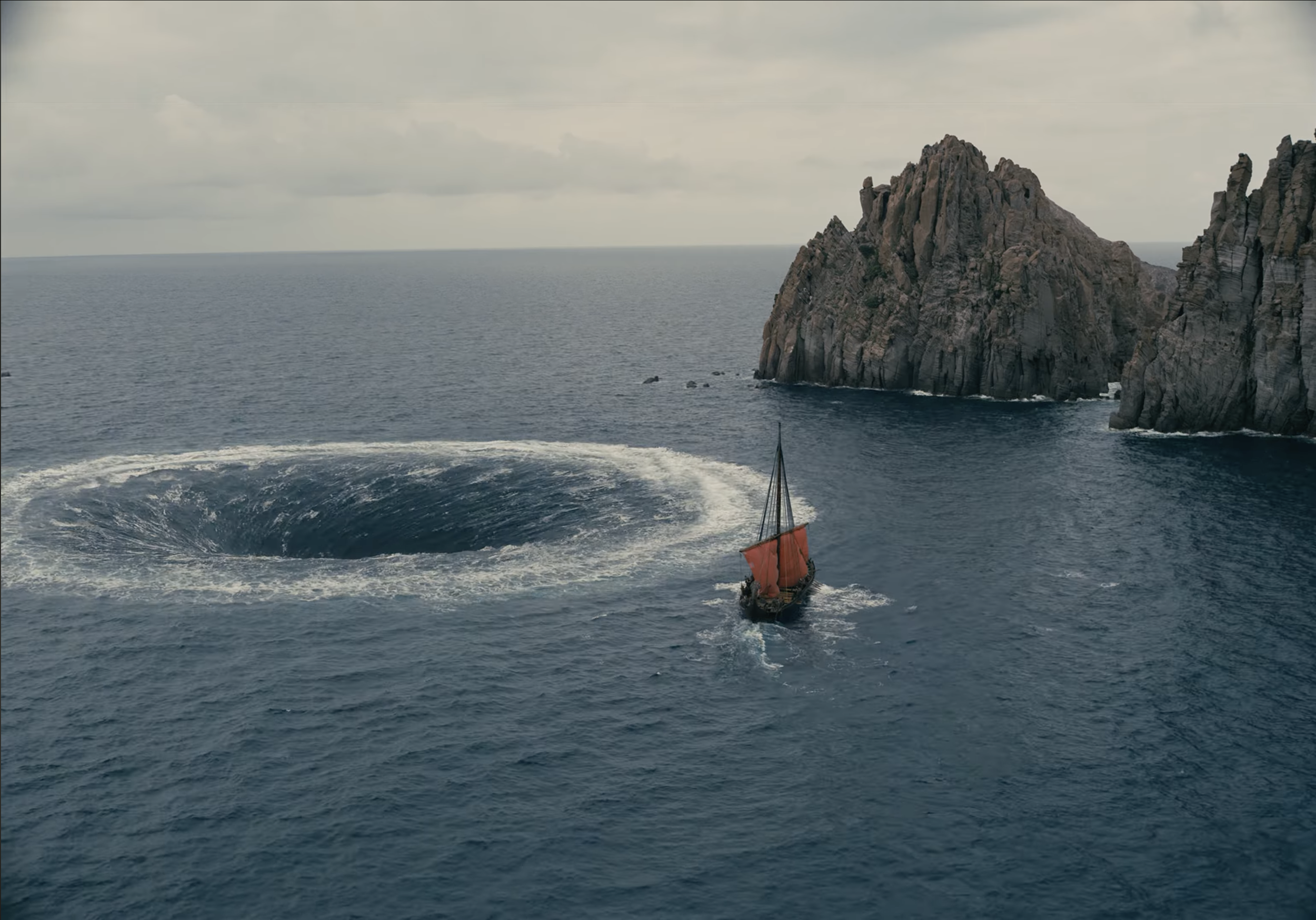
As expected, The Odyssey is technically superb in every way. From visuals to sound design, this is an absolute masterclass in filmmaking. Hoyt Van Hoytema’s cinematography is appropriately gargantuan, and must be seen in all its glory on the biggest screen possible. Vistas are sweeping and epic, combat scenes are kinetic and visceral, storms on the sea put you directly into the action, and the fact that this is all being done with the limitations of large and cumbersome IMAX cameras is a feat in and of itself.
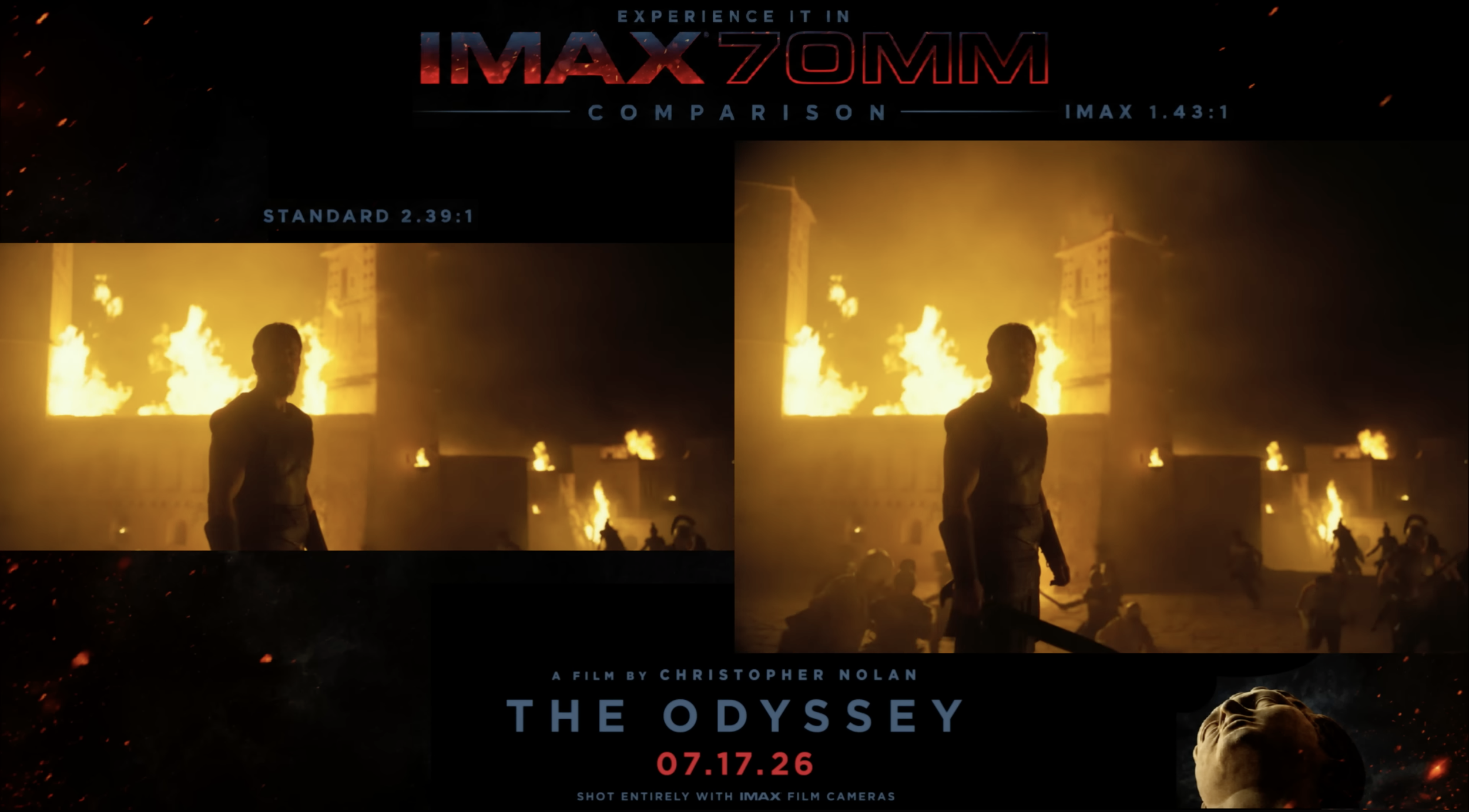
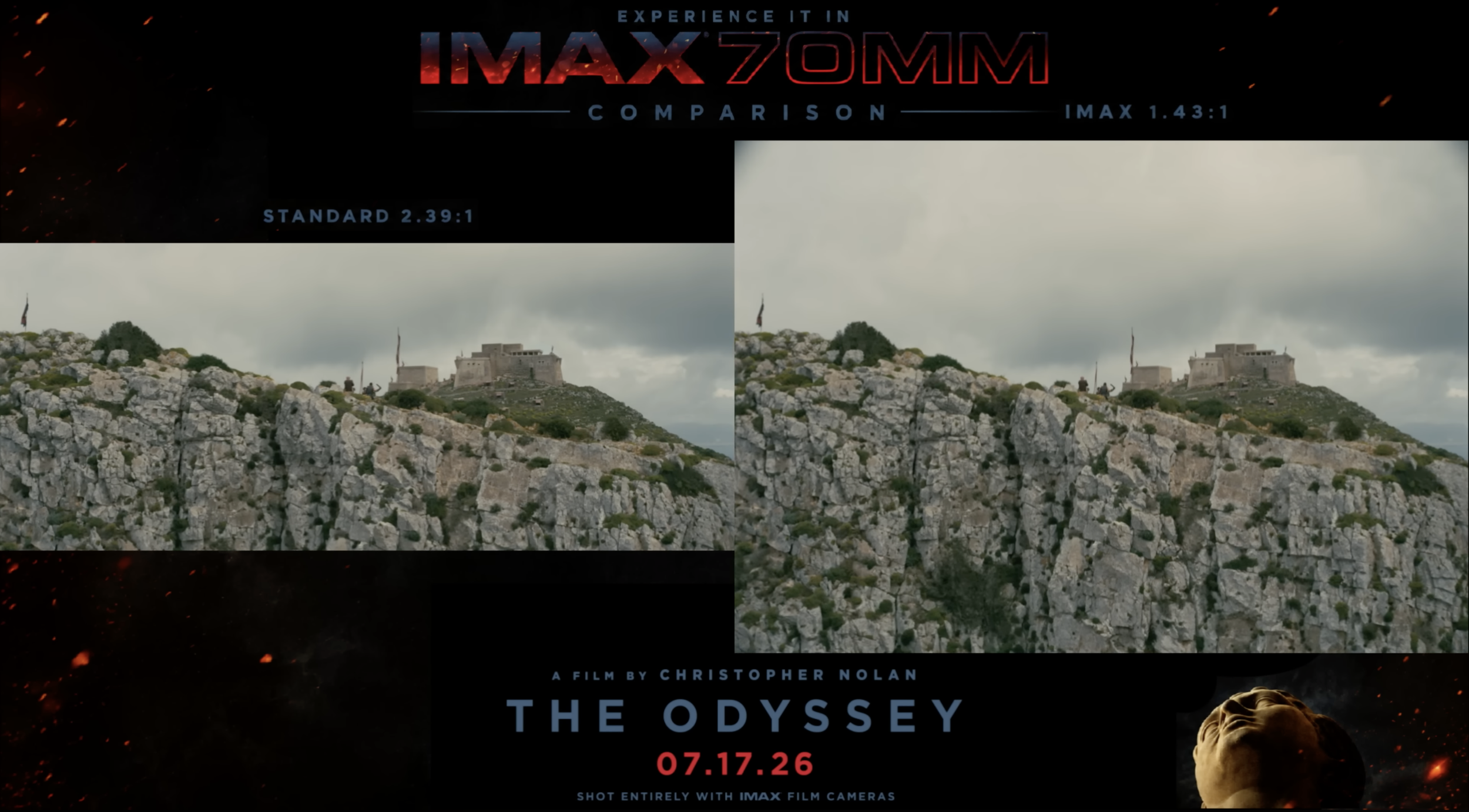
You might be experiencing some FOMO (like me) for not having access to a proper 70mm IMAX theatre, but rest assured that shots are composed to look great in any format. Sure, you are absolutely missing out on up to 30% or more of the full frame, but the film is still incredibly immersive, and those added bits on the top and bottom are intended to fill your peripheral vision. Personally, I saw it in the 1.90:1 ratio IMAX but I was so caught up in the film that I rarely thought about format or aspect ratios, other than how impressed I was with what I was seeing. The Odyssey isn’t excellent because it is filmed in IMAX but its excellent storytelling, technical mastery, and commitment to practical effects is precisely why it deserves to be displayed in such an impressive premium format.
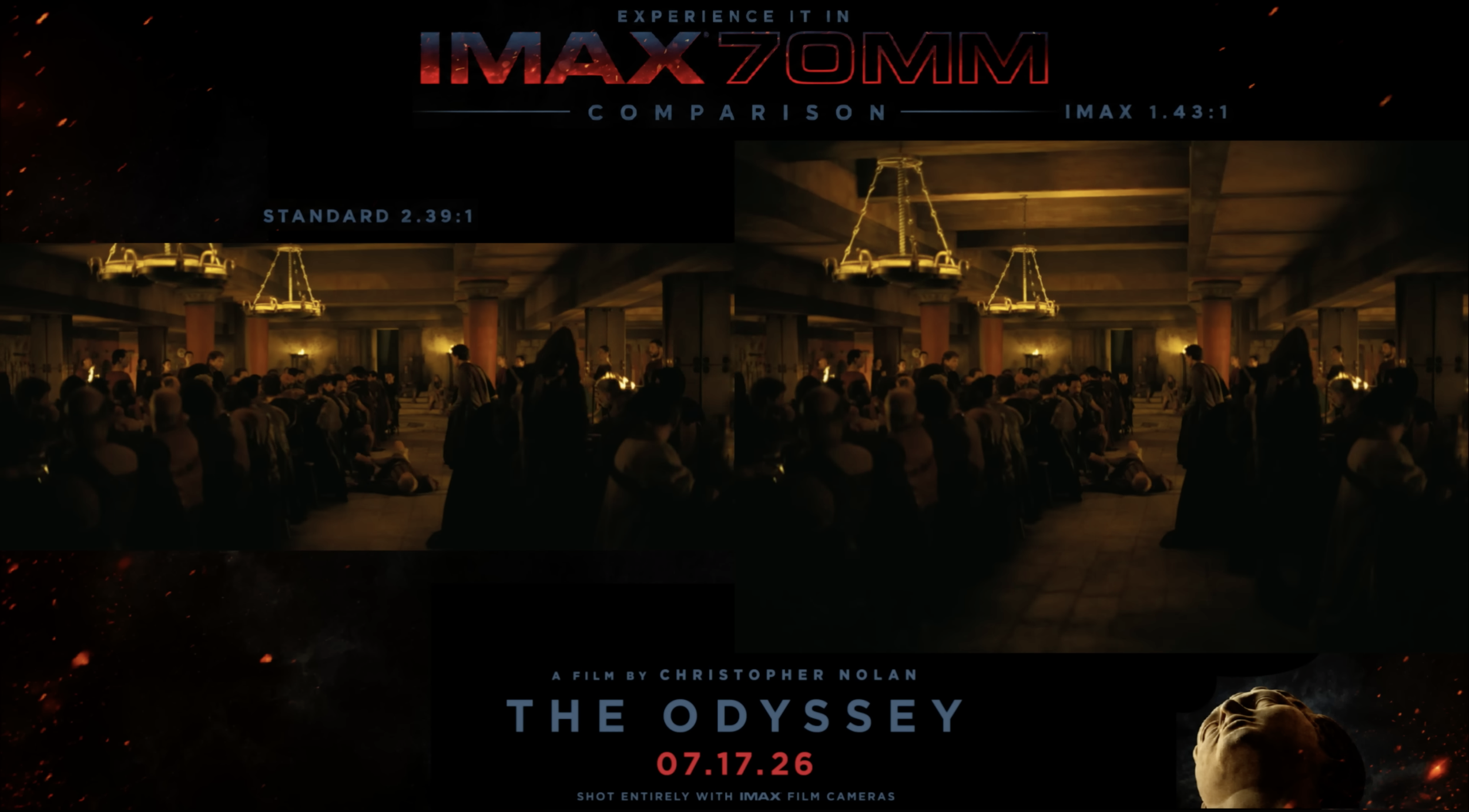
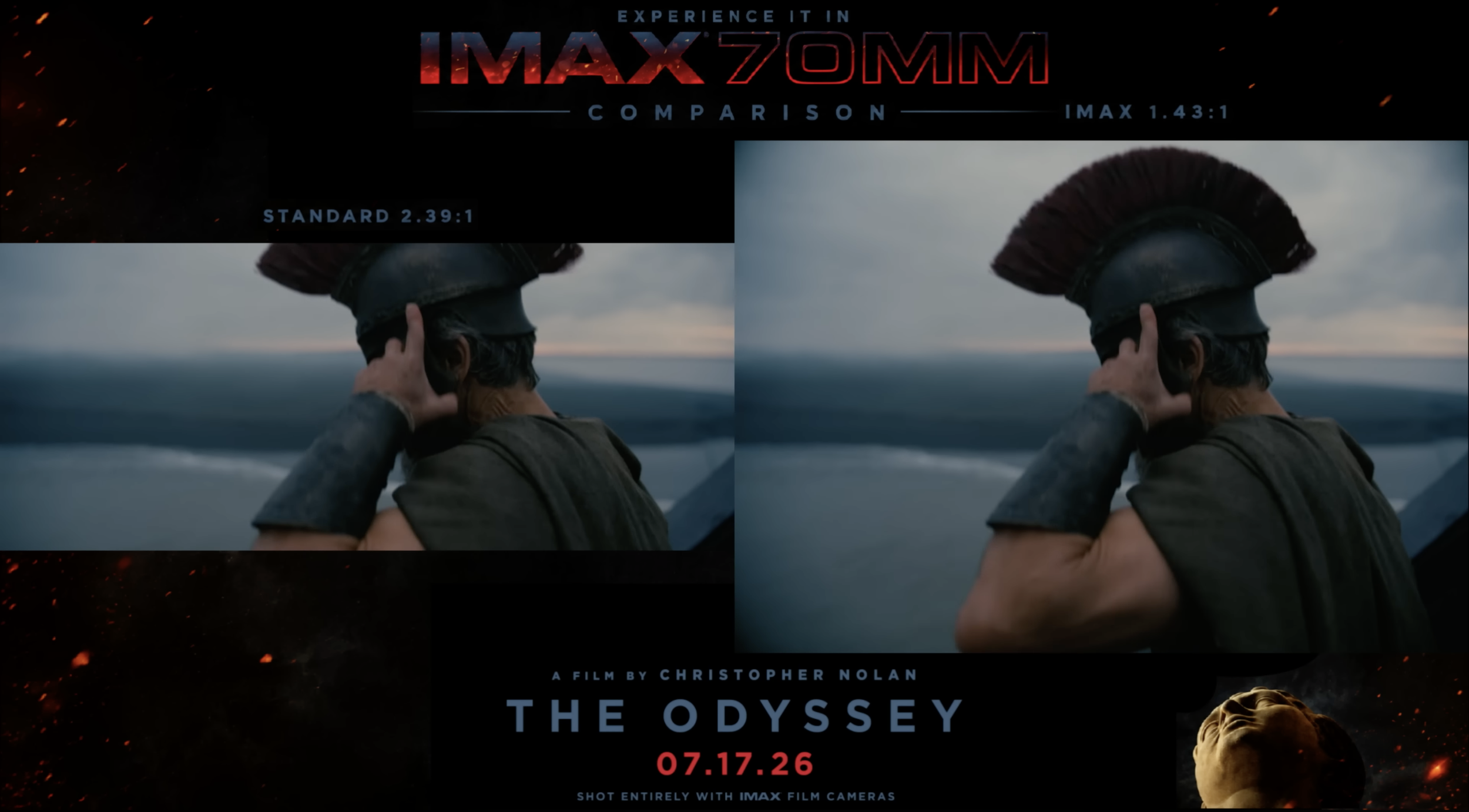
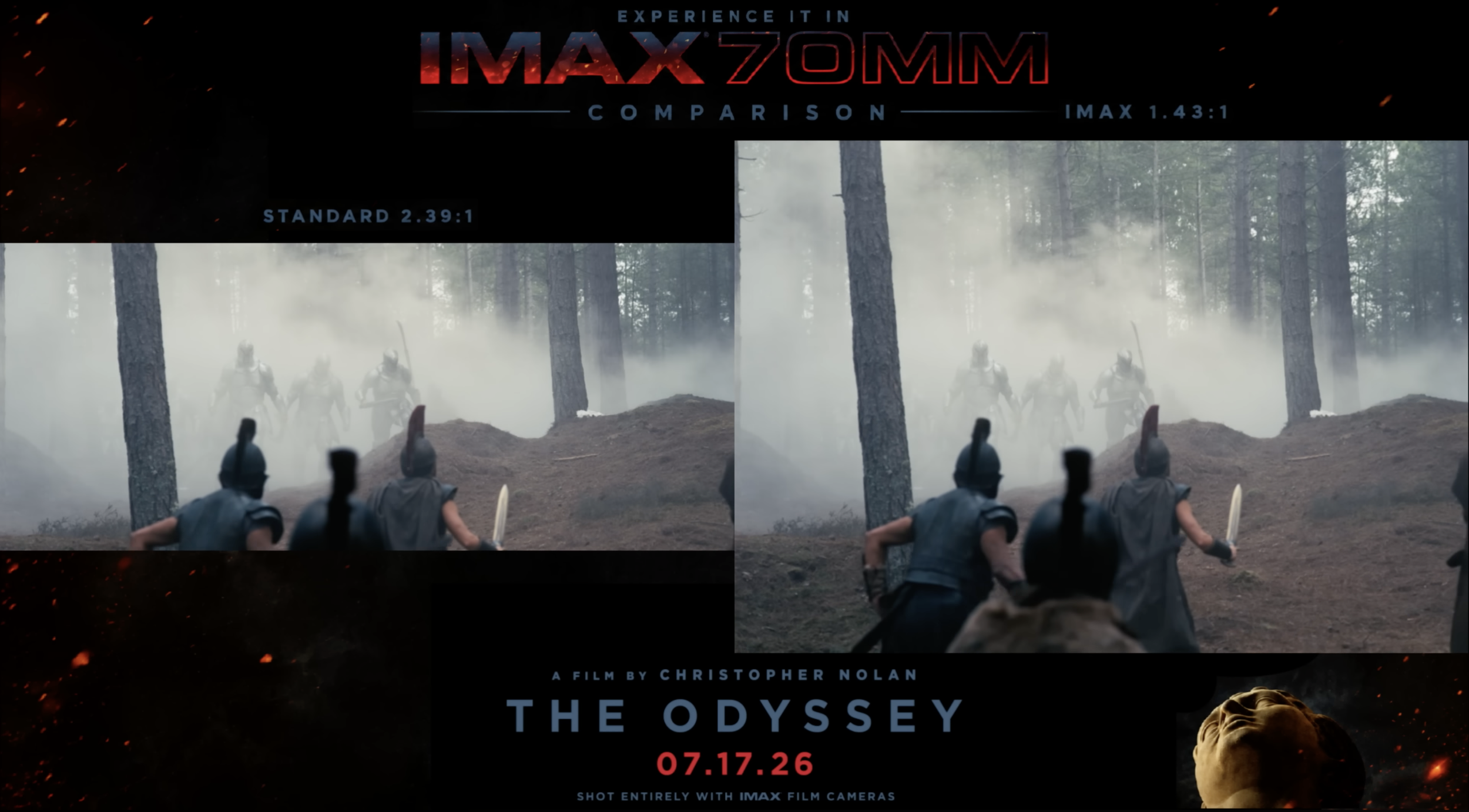
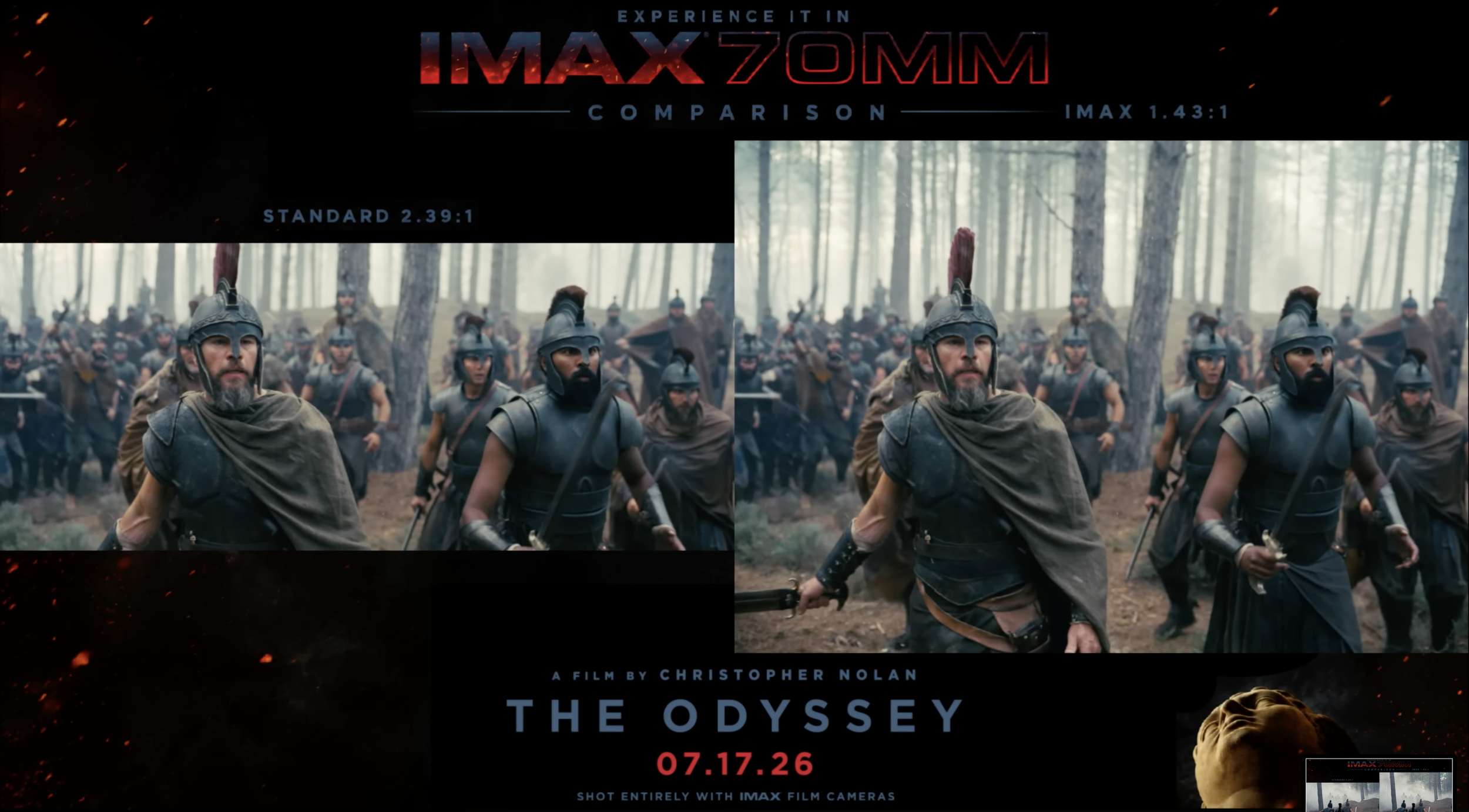
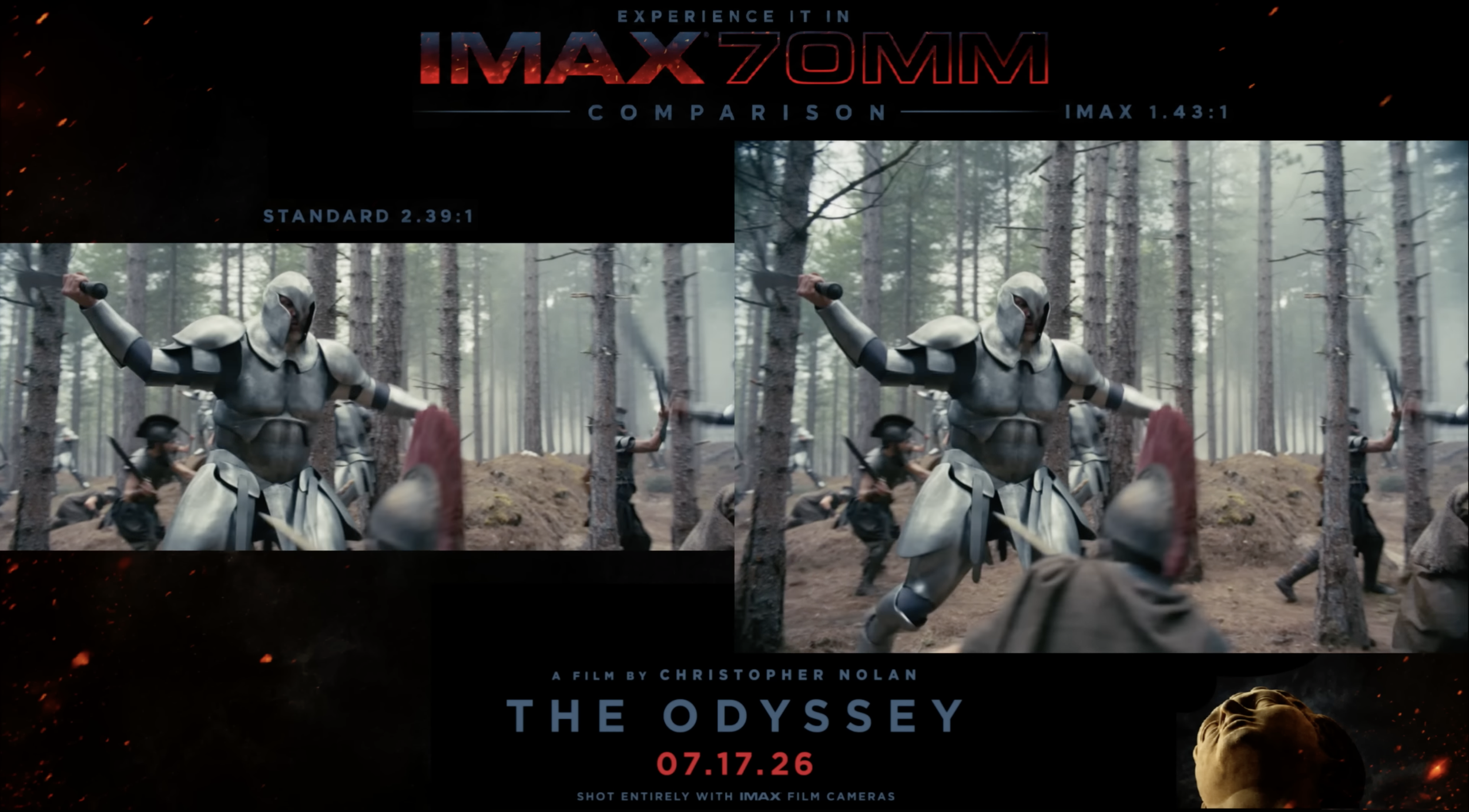
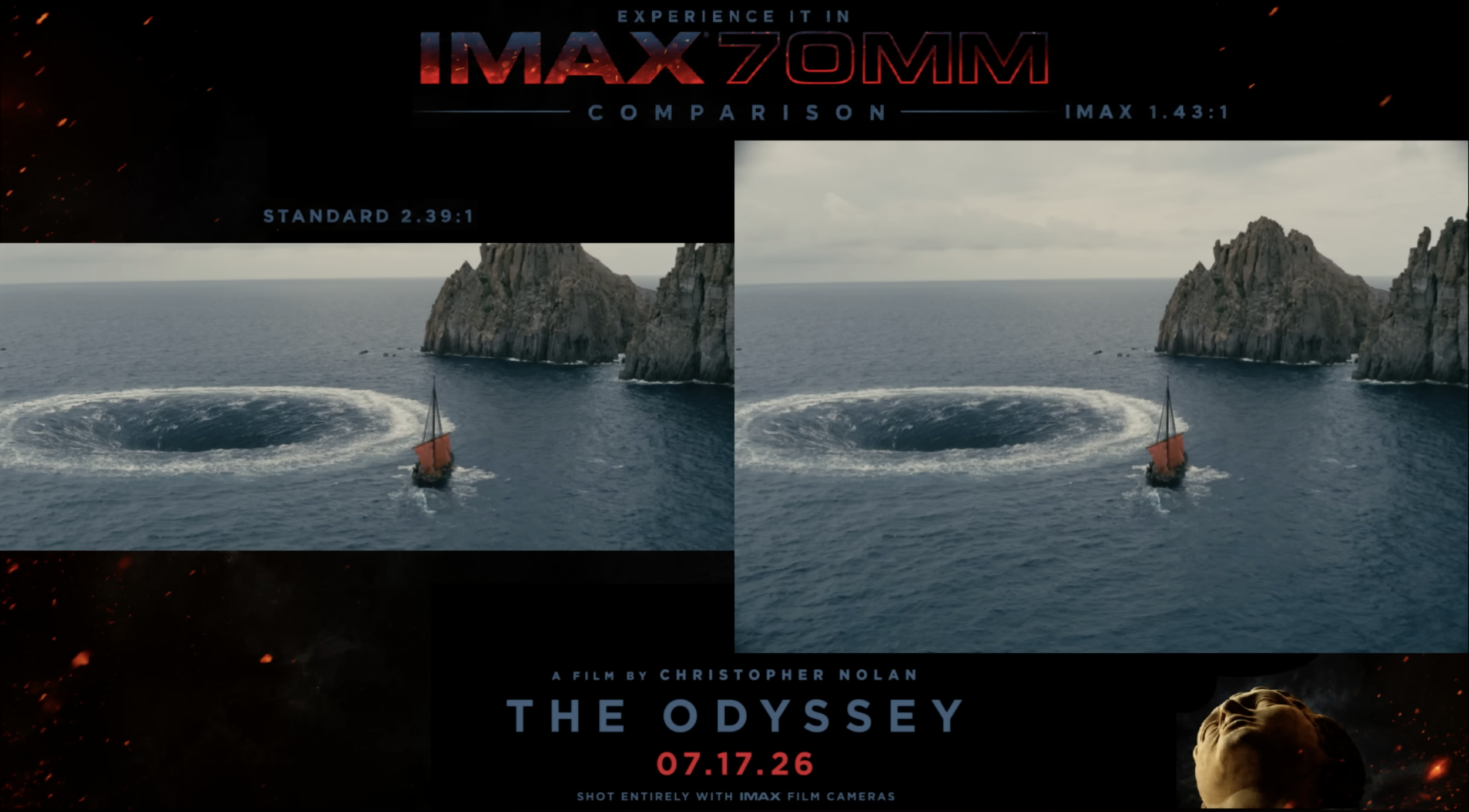
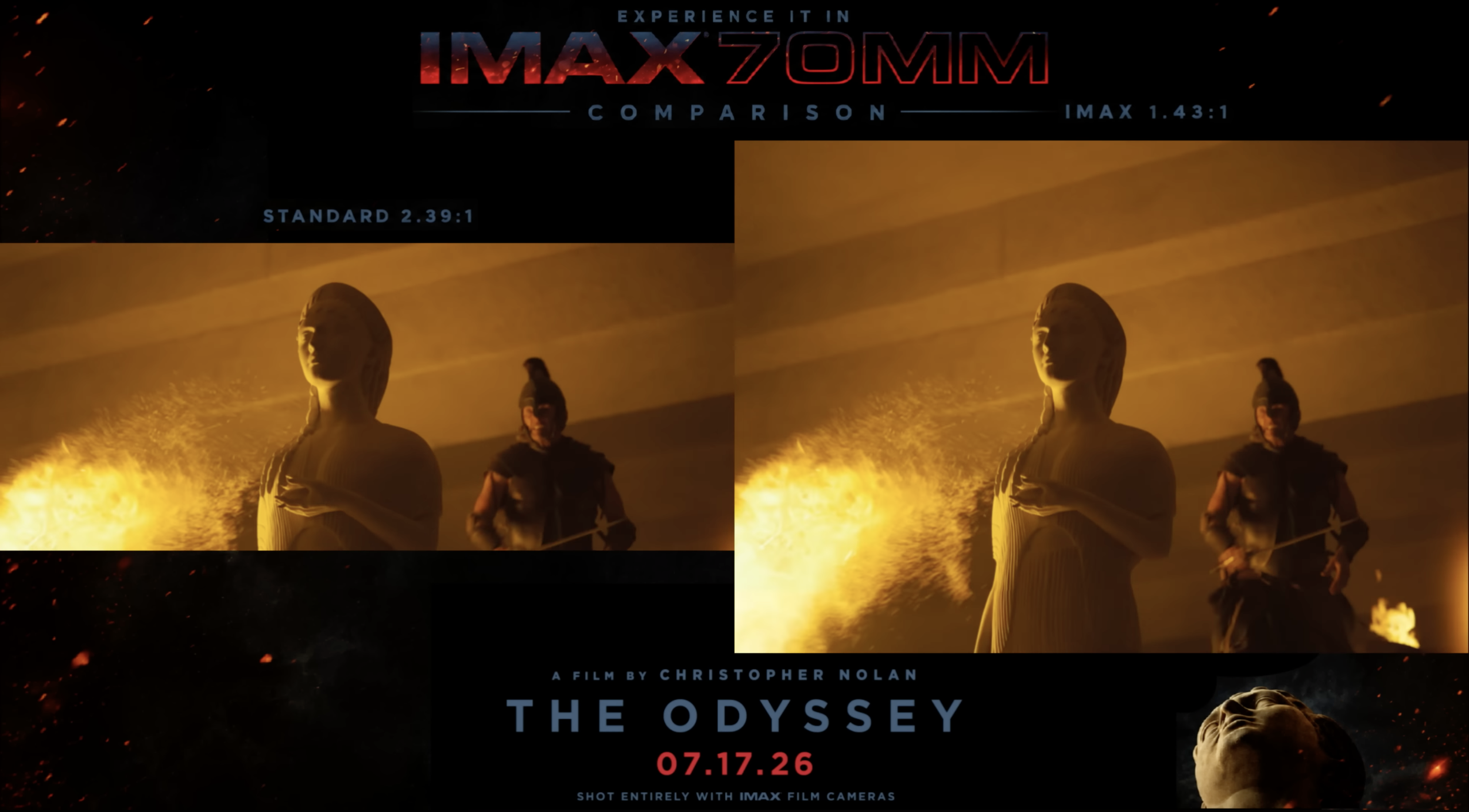
The sound design is even more brilliant, making this one of the most masterfully crafted soundscapes I’ve ever heard. Whether the rumbling crash of thunder or the creaking of a giant wooden horse, this is a glorious audio experience. Ever wonder what a 50-foot giant would sound like wailing in pain inside an echoey cave? Probably not, but it’s not a sound you will ever forget. Terrifying, piteous, and deeply disturbing, it shook the walls of the theatre and transported me into that cave. This is exactly what great sound design does, it takes something fantastical, something that doesn’t exist…that can’t exist, and makes it utterly real.
Another incredibly iconic sound was the sharp twang of Odysseus’ bow string. Beyond just a great sound, it is an element of the narrative that is repeated multiple times, serving as a satisfying exclamation point for a great character moment. That twang is mirrored both as a sound effect and in the music, blurring the line between sound design and the phenomenal musical score by Ludwig Göransson. The soundtrack is resonant and hypnotic, with deep bass throughout every track. Göransson also makes use of period accurate instruments like the aulos (an ancient Greek twin flute) and the lyre (a Greek handheld harp). These unique audio profiles are paired with a haunting and entrancing choir that is at times overwhelming. One of the best tracks, Troy, has an unrelenting metallic percussion. It continuously builds an ever-increasing tempo that made my heart feel like it was about to burst. The emotional range of these tracks is nothing short of exquisite. Somber, overwhelming, resonant, and powerful. For me Ludwig Göransson has secured his position as the best of his generation and he will surely be remembered as one of the greatest of all time alongside Hans Zimmer and John Williams.
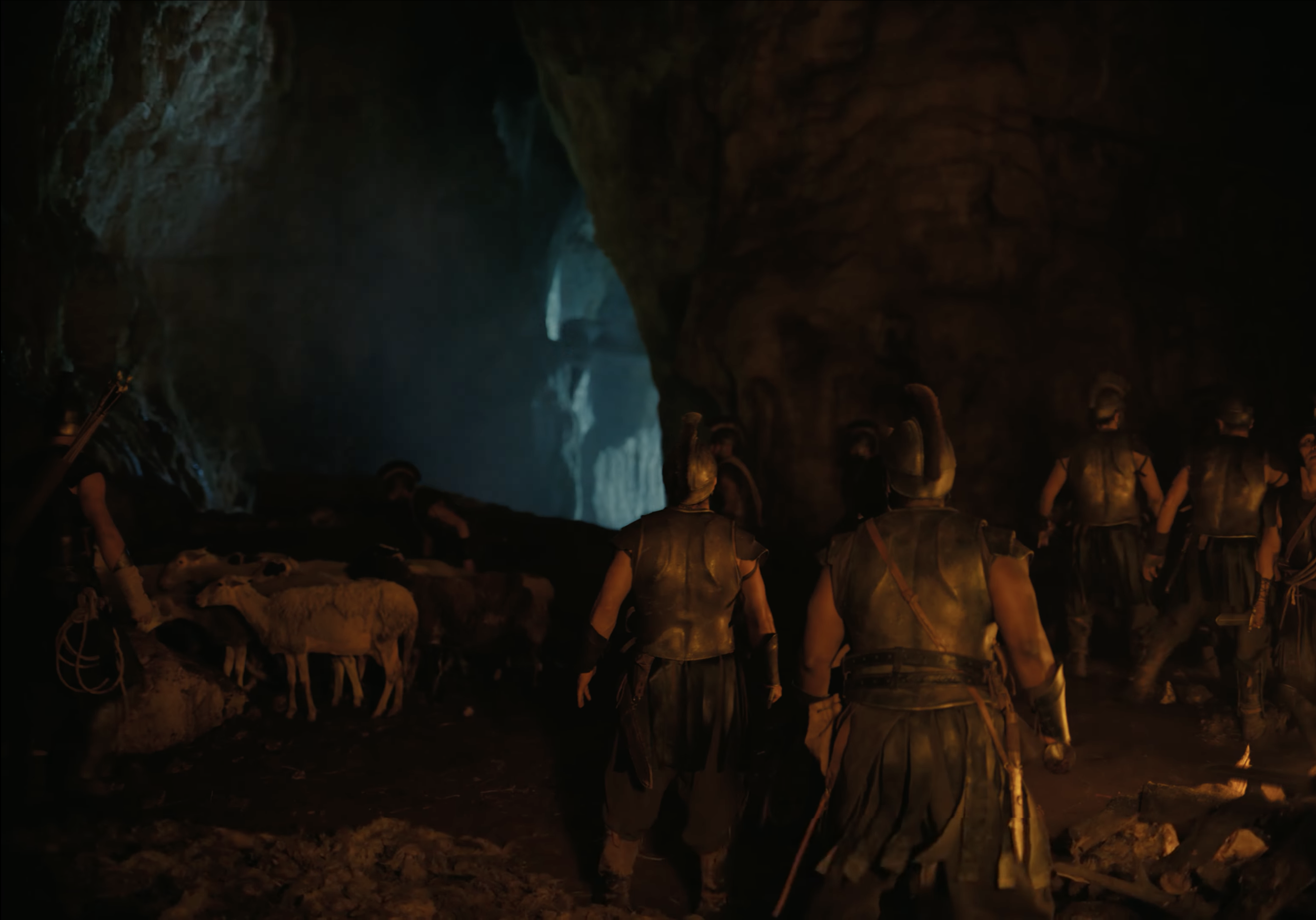
Christopher Nolan has assembled a huge ensemble cast, but using some of the biggest names in Hollywood can cut both ways. Tom Holland as Telemachus is solid but not memorable. He emotes well and conveys genuine vulnerability but often feels like Tom Holland, instead of his character. On the other hand, Anne Hathaway as Penelope transcends herself, carrying a gravitas that elevates the character beyond the patient and loyal wife from the poem.
Lupita Nyong’o, Elliot Page, Zendaya, and John Bernthal, in spite of the marketing (and online controversies) have limited screen time. Page fits the role and Bernthal is fine, but Nyong’o is fantastic despite having such little dialogue. Similarly, Zendaya as Athena is present far less than you’d expect but she is well cast and plays her often stoic self. This is not a very involved role, where she is more of a haunting presence than an active character. Conversely, though barely in any of the marketing, Himesh Patel might have the most screen time next to Damon or Holland. His portrayal of Eurylochus is wonderfully relatable as he shifts between cautious admiration and palpable frustration with Odysseus.
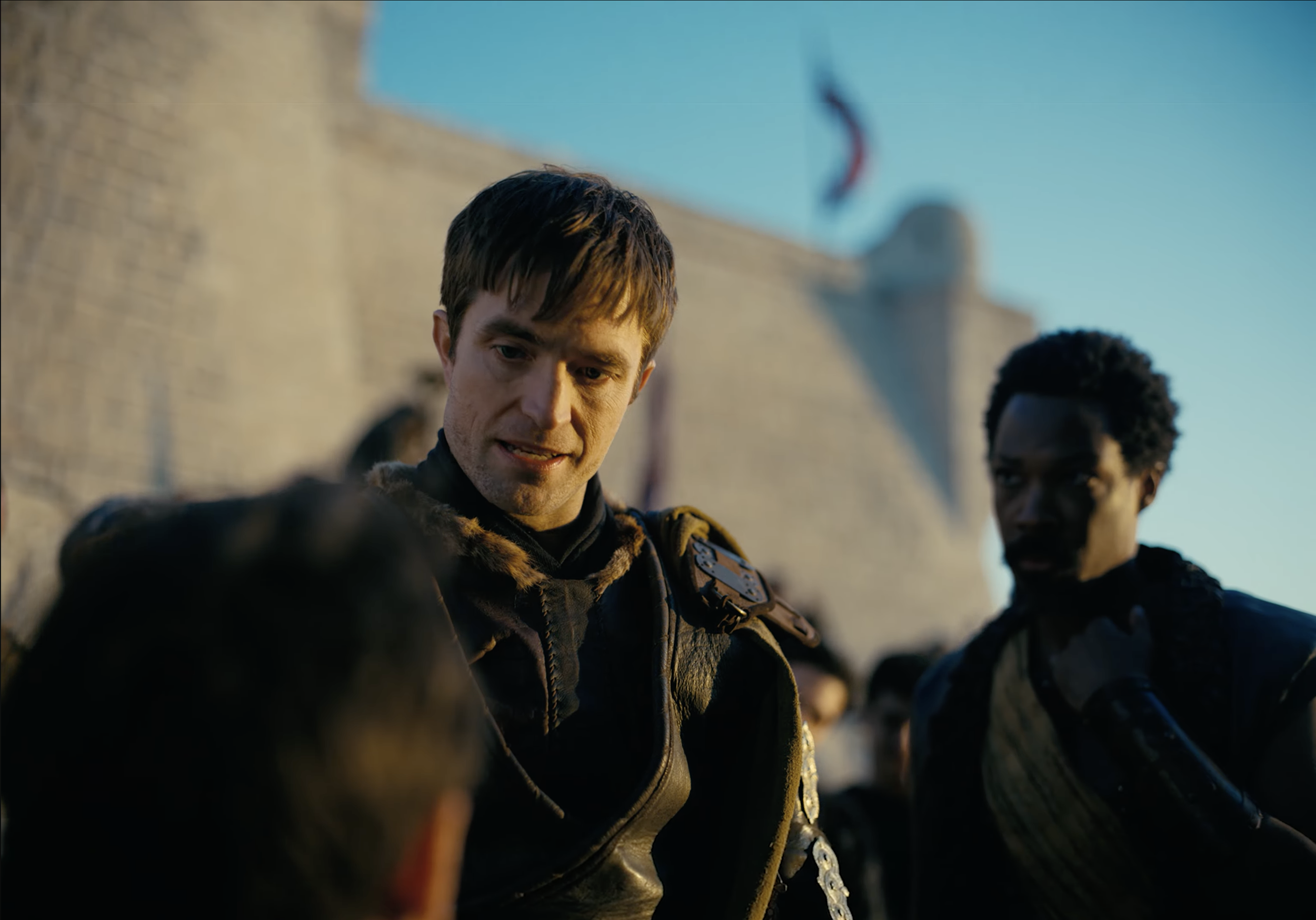
Amidst this massive cast there a few outstanding performances. The first is Robert Pattinson as Antinous. Pattinson is completely detestable, embodying a rat-like cowardice that makes him more pathetic than he is menacing. The slimy smirk, rapid blinks, and unhinged shouting are at times over-the-top, but create a unique character that is a joy to watch. It is truly remarkable that as horrible as he is in the text, Pattinson manages to make Antinous even more vile and pitiful.
The next standout is Samantha Morton as Circei. She is only in one sequence but it is deeply chilling because of her unpredictable performance. Morton balances appearing fearful, imposing, and unhinged with a wisdom that is sinister yet sympathetic. I am still baffled as to how they achieved what happens in this scene with practical effects. Her reassuring line delivery of “Back to your disguises” is so perfect because it is said off screen and played as a throwaway line, yet has immense impact.
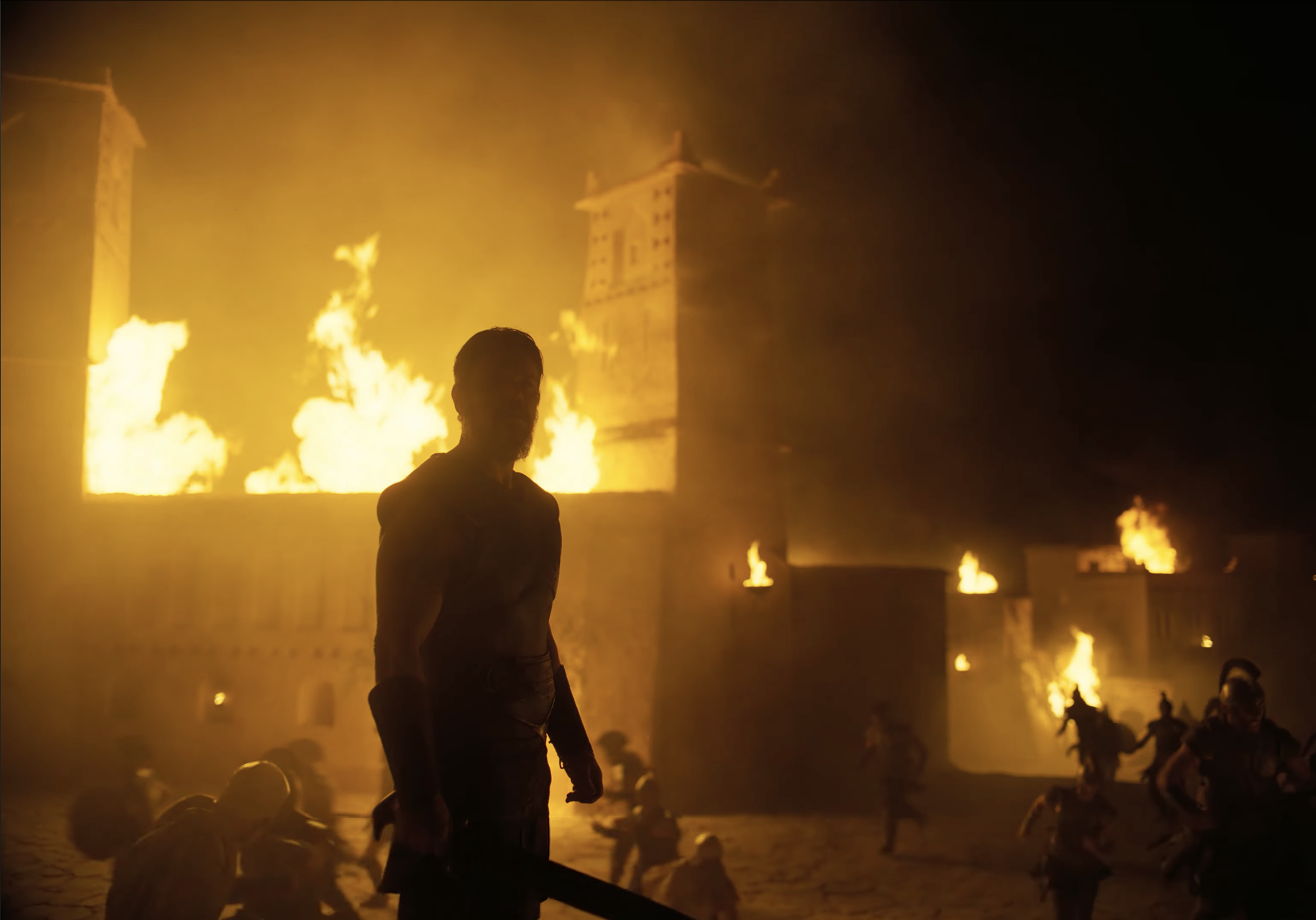
Lastly is Matt Damon, who is so completely immersed in his character that I stopped seeing the actor and only thought of him as Odysseus. This is by far the most powerful and ranged performance of his career. He feels like a capable and brilliant warrior but Damon stands out most when delivering contemplative monologues. Amongst many great scenes there are two that are immaculately acted, the first is his description of the Siren’s song. Damon’s movements, a frantic blend of bliss and torment, are contrasted by a somber narration calmly recalling the experience. The writing is impeccable, distilling a difficult-to-describe mix of emotions and articulating it perfectly. The second is a longer monologue where Odysseus reveals both his inner trauma and the film’s thesis. Damon delivers it with such a raw vulnerability and gravitas that I was utterly entranced. I have always liked Damon but this one scene goes beyond anything I’ve seen from him before.
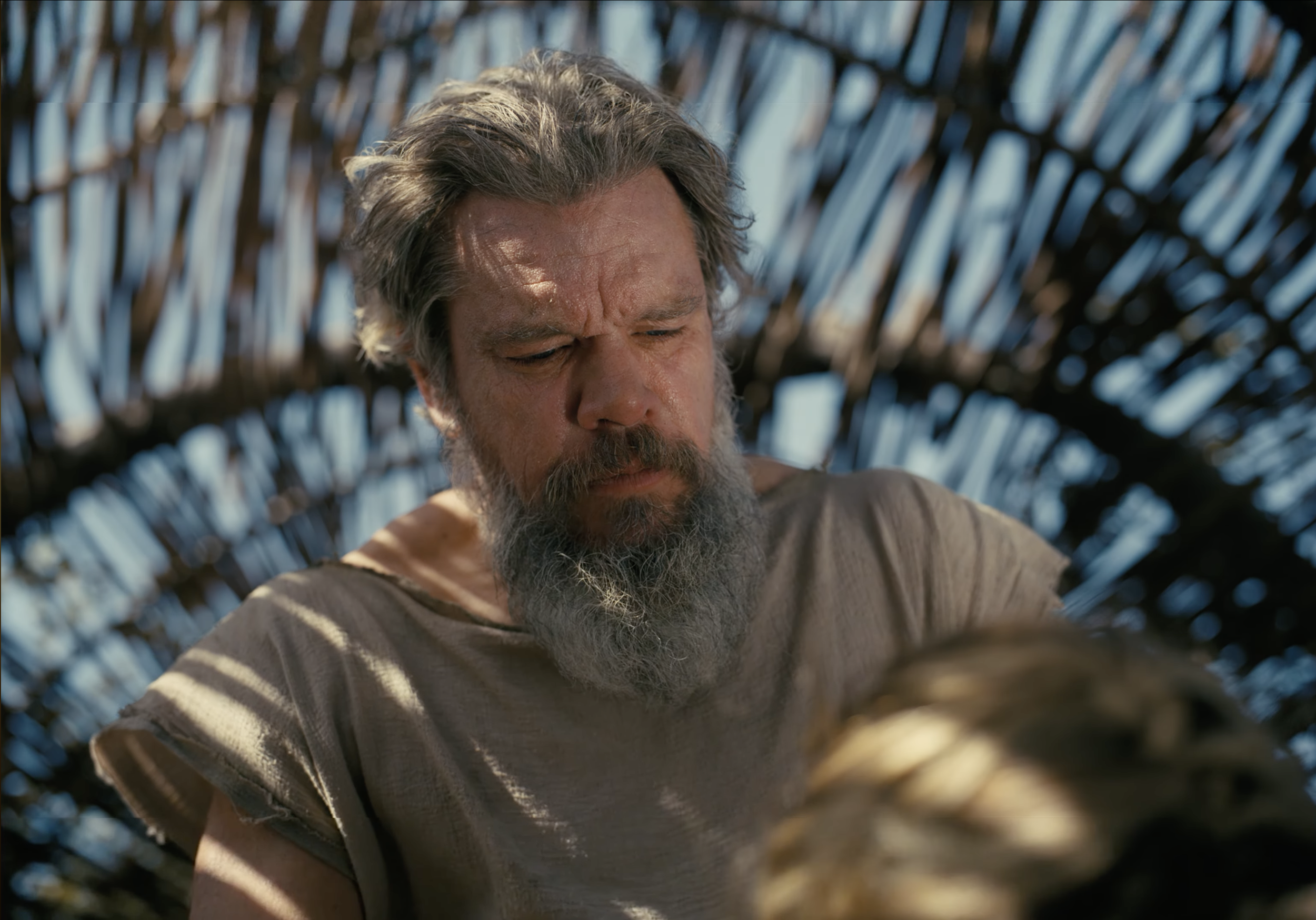
That same scene serves as the cathartic climax we come to expect in a Nolan film. It includes a shot of Odysseus looking up past the camera at something we don’t see. His gaze is endless and overwhelmed. Its shown throughout the film, but its meaning is only revealed in this climactic moment. The revelation along with that monologue is the most pivotal moment in the story, not only for the plot but for Odysseus' character and Nolan’s reading of the text. It is a exercise in recontextualization that Nolan uses often, yet it works just as brilliantly here. This one sequence alone solidifies the film’s excellence for me, elevating it beyond a spectacular reimagining of the epic, into a philosophical statement that the audience is forced to confront.
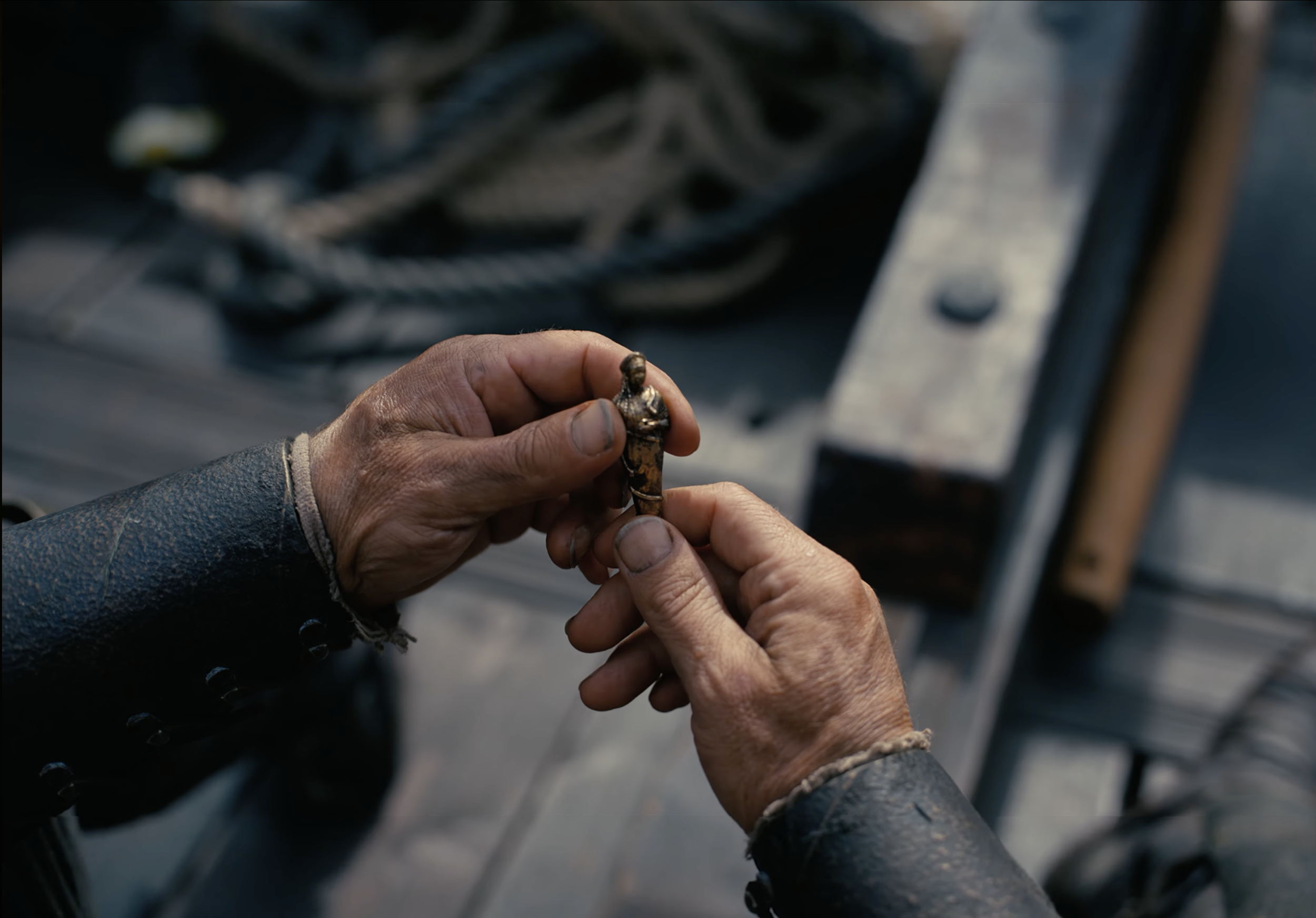
There is an obvious through line between this rendition of Odysseus (who is obviously fictional) and Oppenheimer. Both are brilliant men whose genius changes the course of civilization, but the consequences of their brilliance leave them broken and full of guilt. This civilizational change is one of Nolan’s greatest themes. We see a society in decay, not because of their lack of skill or prowess but due to the loss of values and moral accountability. The story repeatedly references Zeus’ Law, that one must welcome and treat others (especially the guest) with kindness and hospitality. While this tradition may appear absent in the modern world it is still prevalent, especially in more traditional Eastern societies. The rights of the guest and greater community are still held in high regard, although staunch individualism is only growing more pervasive. This added subtext hits harder as Nolan pairs this civilizational shift with a commentary on pride, masculinity, and the covetous desire for conquest, all personified by “the people from the sea”, insatiable marauders spreading destruction across Ancient Greece and potentially the world.
Nolan’s adaptation of The Odyssey succeeds at being the engrossing saga it needs to be. However, what separates it from other adaptations is how it forgoes a direct retelling to instead engage in dialogue with the text. You can absolutely enjoy this without having done any homework or remembering the epic from high school, but as someone who recently reread a translation, it is greatly enhanced if you have refreshed yourself.
Character differences and added context, especially for Odysseus, are intentional and deliberate. Nolan’s variation seeks to interrogate the gap between myth and reality and is made clear by the closing lines of the film. The legend of Odysseus, like many supposedly great heroes, is inevitably sanitized, altered and used. Nolan asks us to question the very concept of myth and story, to look inward at our own perceptions of the world and decide: What great feats do we admire, or ideals do we hold, without considering the consequence, origin, or meaning behind them? This commentary is fully appreciated when comparing the film to the source text. So while you don’t need to read Homer to enjoy this, you’re experience and appreciation for the deeper themes will be greatly enhanced if you are aware of how the film differs.
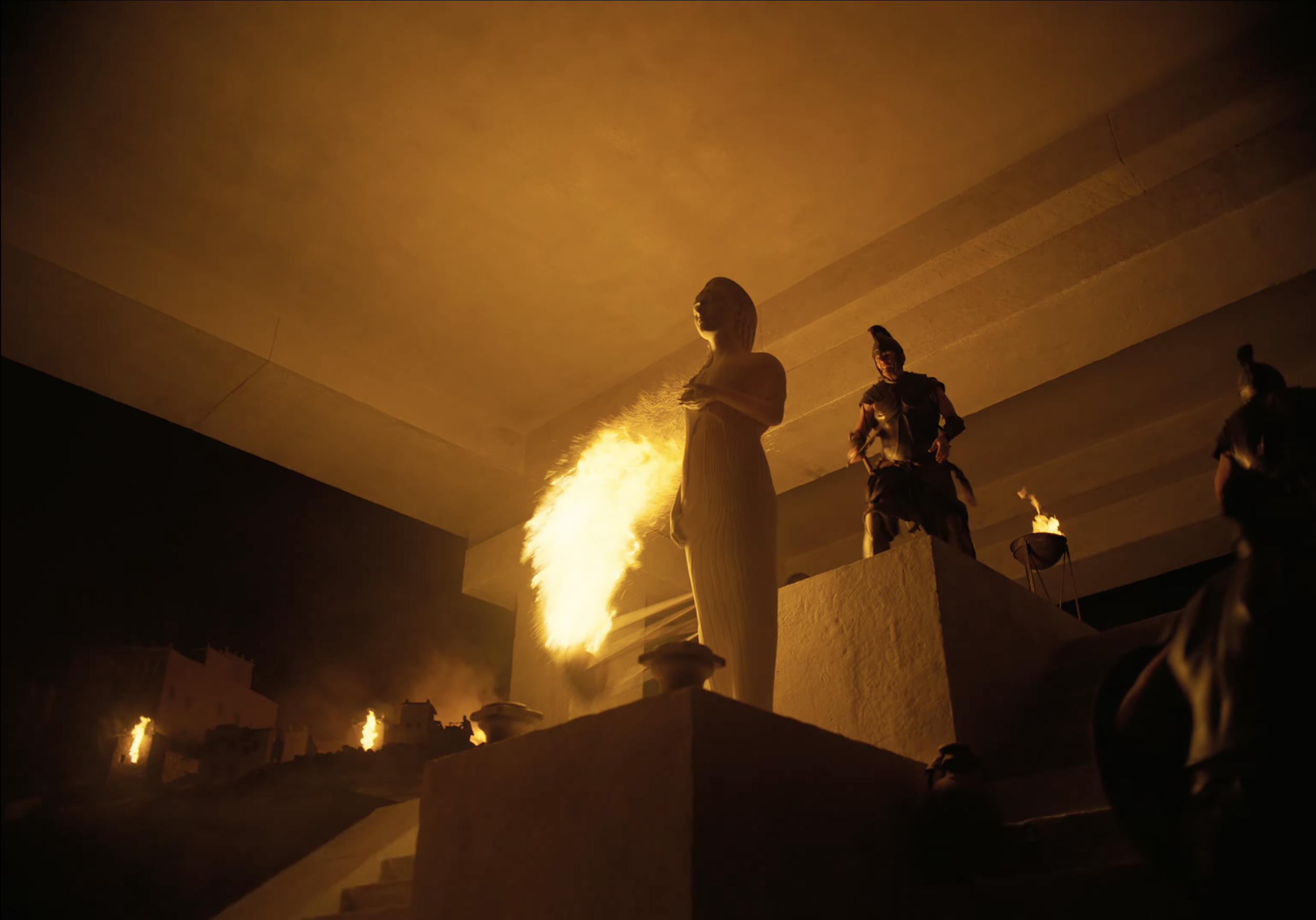
The Odyssey may not be Nolan’s best work, but it is certainly his most ambitious and grandest in scale. Partly in how its shot, but more so in the boldness with which he expresses his points. There are a handful of moments that may feel out of place, but they only stand out as lacking when compared to the incredibly meticulous filmmaking that makes up the other 99% of this movie. This is a genuinely moving, enthralling, and deeply epic saga that relishes in its reinterpretation and uses that variance to convey an even more poignant message.
9/10 - An immense and powerful journey presented with gargantuan scale and boundless ambition. As the first feature film shot entirely in IMAX, this is revolutionary filmmaking. Nolan’s interpretation of The Odyssey continues the tradition of mythology by adapting it to our time and making it an event worthy of grandiose spectacle. An incredible cinematic experience that proves why we still need theatres, especially the gigantic ones.
Tie me to the mast, because I'm tempted by the Siren's call to take an excessively long road trip, to see this in proper 70mm IMAX.
The Odyssey was dedicated to the memory of the late David Keighley, Chief Quality Officer at IMAX who passed away last year. I can personally attest, as can many others, that he would respond (even late at night) to geeks like me emailing about issues at the local IMAX. I only later learned that Keighley was a pioneer in large format film production and worked closely with giants of the industry like Christopher Nolan. They even named the newly designed camera used to shoot The Odyssey after him. Glad to see him honoured for his work.

A spoiler-free review of Masters of the Universe, Travis Knight’s tongue-in-cheek action adventure comedy about the classic Saturday morning cartoon hero.